
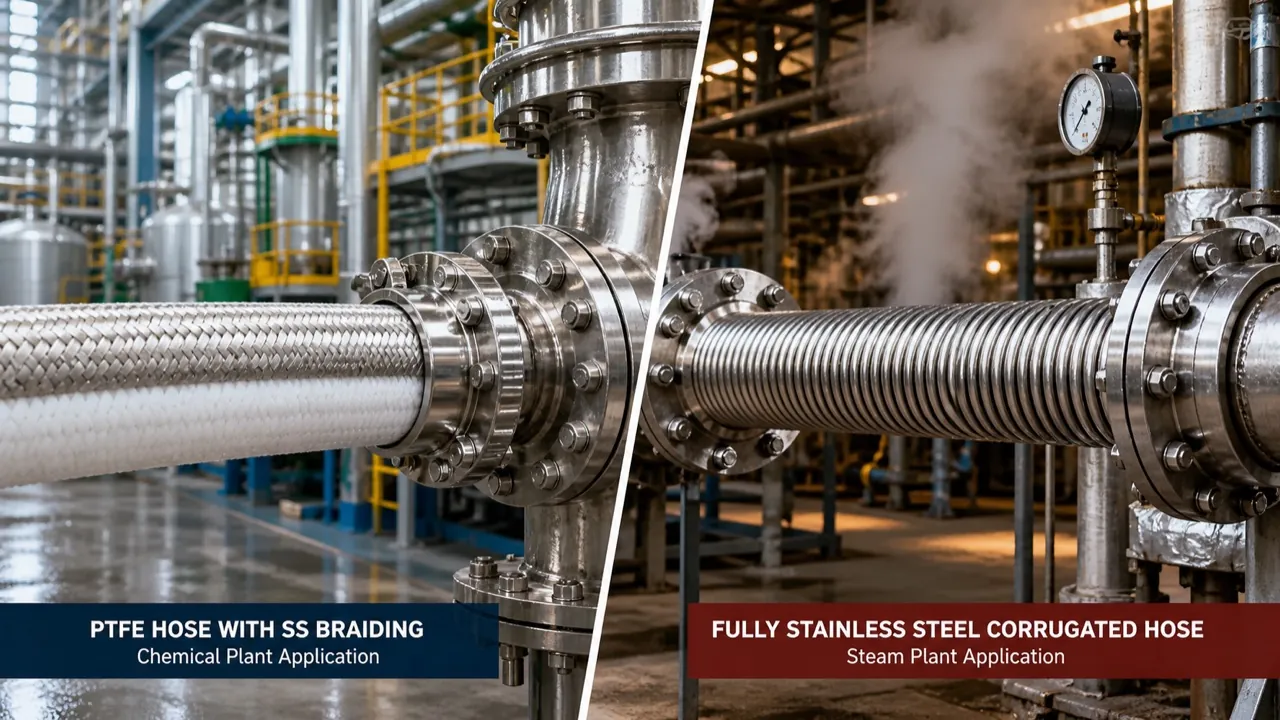
Both are industrial-grade flexible hoses — but they solve different problems. A practical comparison across chemical resistance, temperature, cleanliness, and cost, with application examples from pharma, chemical, and food industries.
We manufacture both, and the question comes up daily: PTFE or SS metal? The honest answer is "depends on the medium" — here are the decision factors.
Chemical Resistance
PTFE is virtually inert to every industrial chemical short of molten alkali metals and elemental fluorine. SS 316 handles most chemicals but fails against strong acids like hydrochloric. If your plant has aggressive chemistry, PTFE wins.
Temperature
SS corrugated hoses tolerate cryogenic temperatures down to −270°C and up to +700°C with 321 grade. PTFE operates between −70°C and +260°C. For extreme temperatures, only metal will do.
Cleanliness & Purity
PTFE has a smooth, non-stick bore that prevents buildup and contamination — the reason it dominates pharma, semiconductor, and food/dairy service. Metal hoses with corrugated bore can trap residue unless convoluted PTFE lining is added.
Flexibility & Bend Radius
Smooth-bore PTFE hoses have limited flexibility; convoluted PTFE is more flexible but still not as bendy as corrugated SS. For tight routing, metal usually wins.
Cost
SS corrugated hoses are typically 30–50% cheaper than equivalent PTFE for the same pressure rating.
Rule of Thumb
Extreme temperature or budget-sensitive → SS metal. Aggressive chemicals or purity-critical → PTFE. Need both? We do PTFE-lined SS-braided assemblies that combine the two.