
Not all stainless steel is the same. A quick decision guide on when to specify 304, when to upgrade to 316, and when 321 is non-negotiable — with real-world examples from petrochemical, marine, and high-temperature service.
Specifying the right stainless grade is the single biggest lever you have over hose life, and the one most frequently got wrong. Here is a practical breakdown.
SS 304 — The Everyday Workhorse
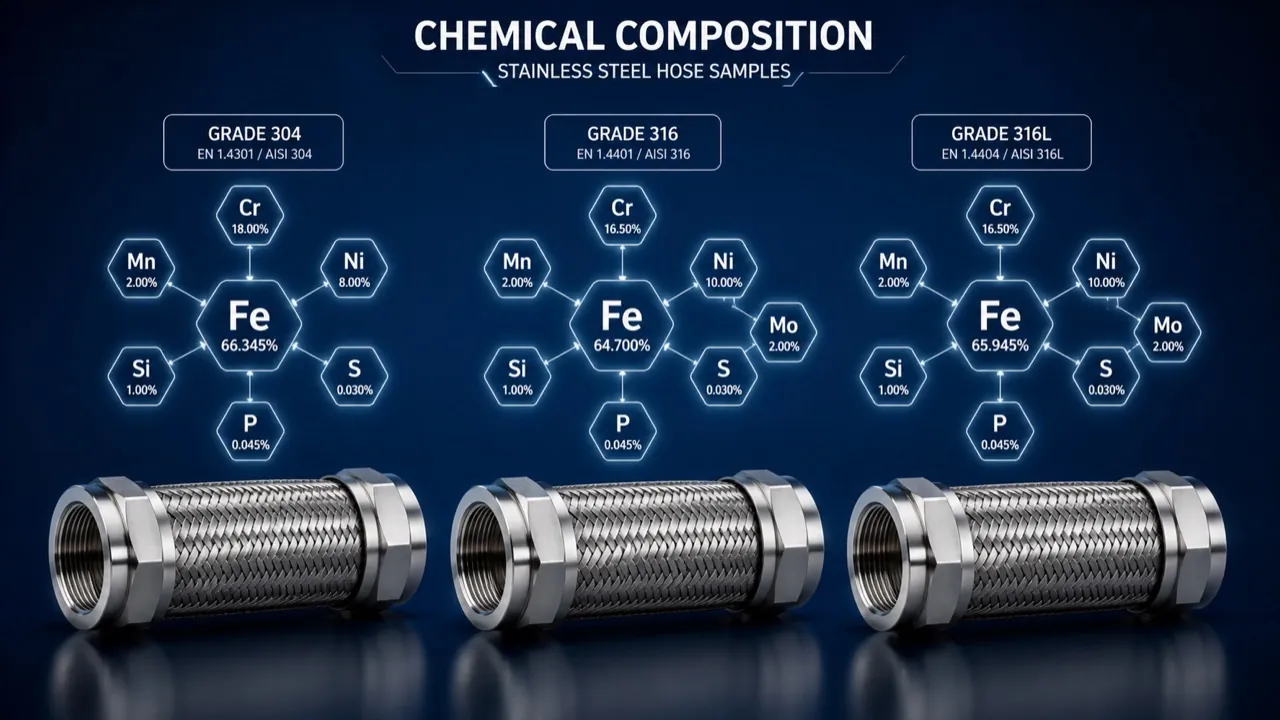
18% chromium, 8% nickel. Excellent corrosion resistance in dry, clean environments. Best for compressed air, water, steam below 300°C, inert gases, and general plant services. Loses performance fast in chloride or acidic service.
SS 316 — When Chlorides Enter the Picture
The 2–3% molybdenum addition in 316 dramatically improves pitting resistance in chloride-bearing media. Specify 316 for seawater, coastal atmospheres, brines, bleach, many acids, and pharma/food contact. If your process has any chloride content above trace levels, 304 is false economy.
SS 321 — Built for Heat
321 is 304 stabilized with titanium. The titanium locks up carbon so it cannot precipitate as chromium carbide at grain boundaries during prolonged exposure to 425–815°C. That matters for exhaust gas, jet engine ducting, superheated steam, and furnace flex joints.
Decision Shortcut
Clean air/water/steam ≤ 300°C → 304. Any chlorides, seawater, food, pharma → 316. Sustained high temperature or cyclic heat → 321. When in doubt, ask — we have datasheets and chemical resistance tables on request.