Reliance MET City, P-07, Sector-2B, Silana, Durina, Haryana 124103

+91 85958 70426

sales@flexiblemetals.in

Correct Assembly Installation

Why correct installation matters

Improper use of SS Corrugated Hose, or damage to the hose, such as bending, kinking, twisting, flattening or crushing, permanently alters its characteristics. Even if the hose appears to be restored to its original shape, it will no longer perform to specification, so it is important to prevent these occurrences.
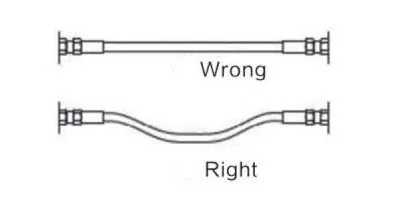
Hose installed with slack to allow for length change under pressure surges

Since a hose may change in length by +2% to −4% under pressure surges, provide sufficient slack for expansion and contraction.

Hose installed without twist, so that machine motion bends it rather than twists it

Hose should not be twisted. A hose is weakened when installed in a twisted position, and pressure in a twisted hose tends to loosen fitting connections. Design so that machine motion produces bending rather than twisting.

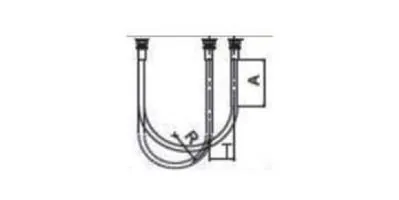
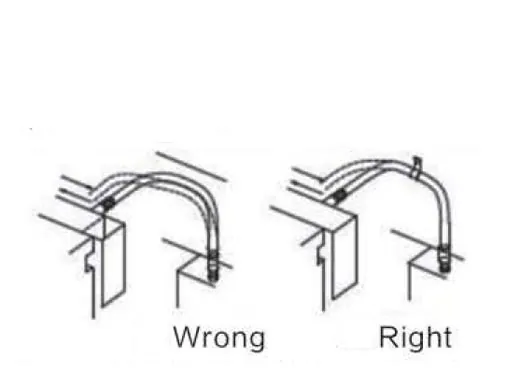
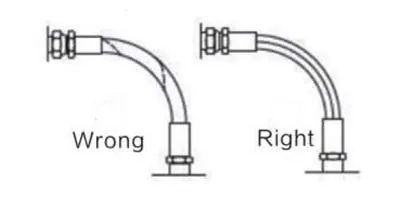
Bend kept at or above the minimum radius and clear of the hose fitting

Never use a bending radius less than the minimum shown in the hose specification tables. The bending radius of the hose should be far away from the hose fitting (A>1.5R)

Hose connected with sufficient length

Leave sufficient length when the hose is connected.

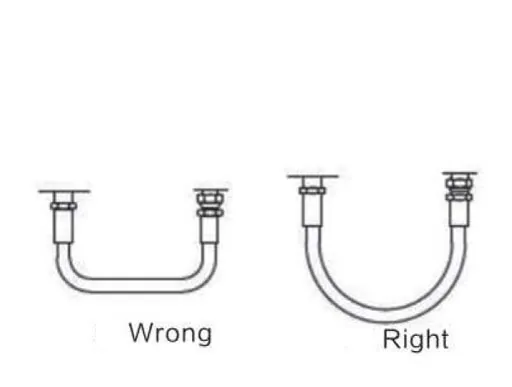
Proper fittings used to avoid an over-tight bend radius and excess force

Choose proper fittings; avoid an over-tight bend radius and excess force.

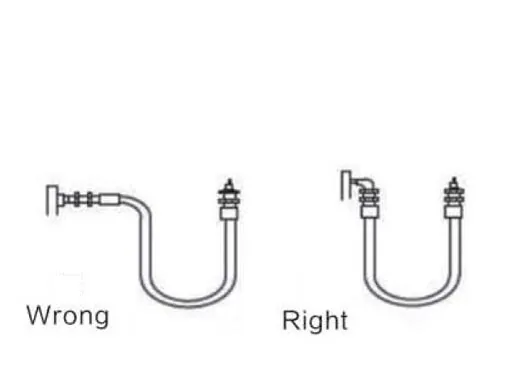
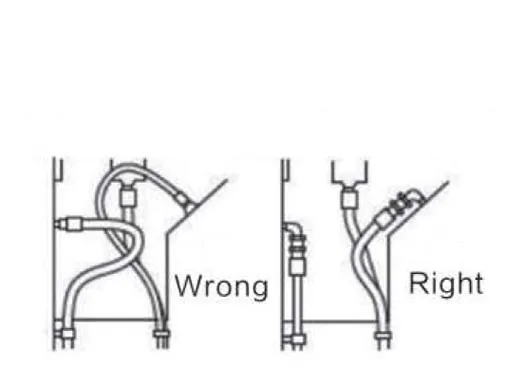
Proper fittings used to avoid twisting in a hose line bent in two planes

Choose proper fittings; avoid twisting in hose lines bent in two planes.

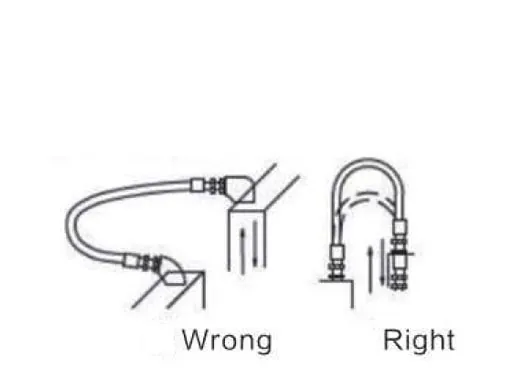
Proper fittings used to avoid excessive hose length

Choose proper fittings; avoid excessive hose length.

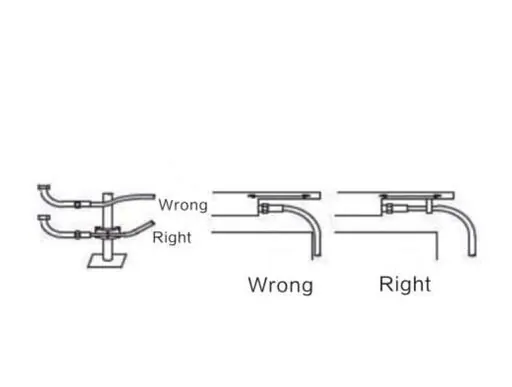
Hose clamped correctly to avoid twisting

Avoid twisting the hose by clamping it correctly.

Hose routed clear of nearby objects to prevent rubbing

Reduce friction: prevent the hose from rubbing against nearby objects, and route it clear of them where possible.

Get Quote WhatsApp