
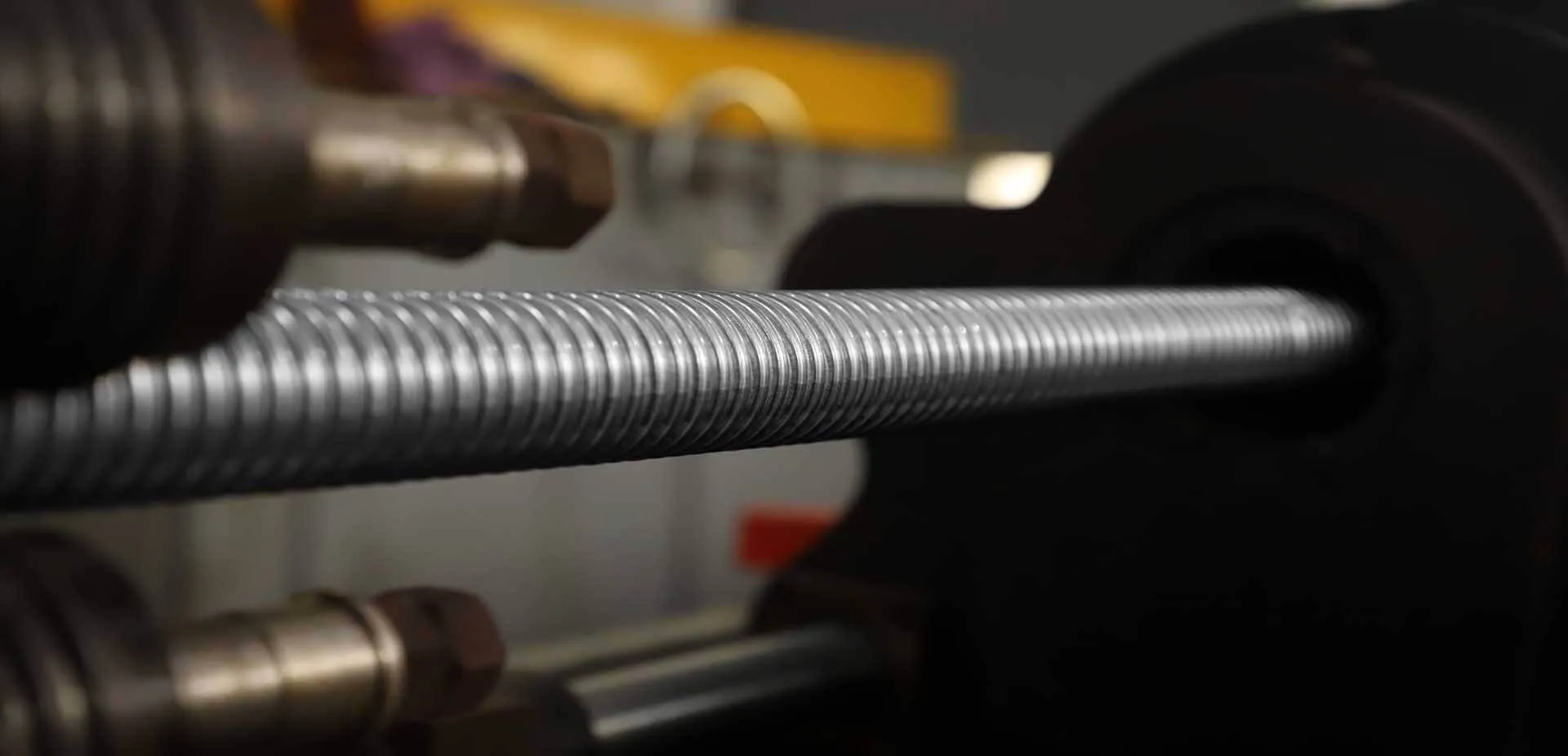
Two hoses can share a bore, a wall thickness and a material and still behave nothing alike. The difference is whether the convolutions are closed rings or one continuous spiral.
Corrugated metal hose comes in two geometries, and the choice is usually made by habit rather than by requirement. It is worth making deliberately, because it decides how the hose bends, whether it drains, and how much care the termination needs.
Rings, or one continuous groove
Annular hose is formed as a series of closed rings, each one a complete circle at right angles to the axis, stacked along the length like a column of washers. Every convolution is independent of its neighbours.
Helical hose is formed as a single continuous spiral running the whole length, like a very coarse screw thread. There is one convolution, and it never closes.
That single difference drives everything else.
What annular does better
- It bends the same way in every direction. With no helix angle there is no preferred plane, so the hose behaves identically whichever way you route it.
- It does not try to rotate under pressure. A pressurised helix wants to unwind slightly, which puts torsion into the assembly and into whatever it is bolted to. Closed rings have nothing to unwind.
- It terminates cleanly. Each ring is a closed circle, so the joint at the fitting has no continuous groove running under it and out the other side.
- It generally turns tighter, and it is the geometry to use for anything that flexes repeatedly in service.
What helical does better
- It drains completely. Install it with a fall and liquid runs straight out along the spiral. An annular hose has a ring at every pitch, and each one is a small trap — which matters for hygienic duty, for lines that must be dried between batches, and for anything that would freeze.
- It suits long continuous lengths, and is often the more economical choice for conduit, ducting, vacuum lines and drainage where flexing is occasional rather than constant.
Where helical costs you
The spiral gives the hose a preferred bend direction, so routing is less forgiving. Under pressure it adds that unwinding torque. And because the groove runs continuously to the end of the hose, the termination has to be designed so the spiral is properly closed off rather than merely clamped over.
Choosing between them
- Anything that flexes in service, or vibrates, or moves with a machine — annular.
- Anything that must drain dry, or be cleaned between batches — helical, unless the flexing requirement rules it out.
- High pressure with a braid over it — annular, because the termination is the weak point and closed rings seal more predictably.
- Long runs of conduit or ducting at low pressure — helical is usually the economical answer.
We manufacture both geometries. If you are unsure which suits the duty, send us the media, the pressure, the temperature and how the line moves, and we will come back with a specification rather than a catalogue page.