
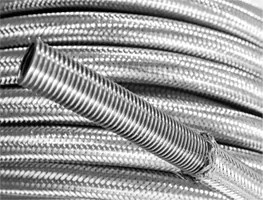
Use the static figure on a line that moves and the hose fails early. Use the dynamic figure on a line that never moves and you have specified more hose than you needed. Here is how to tell them apart.
Every hose in our range is published with two bend radius figures, and they are not interchangeable. Pick the wrong one and the hose either fails long before it should, or you have specified a larger, more expensive assembly than the job needed.
The two numbers describe two different jobs
Static bend radius applies to a hose that is routed once, clamped, and then left alone. It absorbs misalignment between two fixed points, takes up thermal growth in a pipe run, or simply gets a line around an obstruction. It bends when it is installed and then holds that shape for its service life.
Dynamic bend radius applies to a hose that keeps moving after commissioning — a line to a pump on anti-vibration mounts, a loading arm, a feed to a machine that traverses, anything that flexes as part of normal operation.
Why dynamic is always the larger figure
Bending a corrugated tube stretches the outer face of every convolution and compresses the inner face. Held once, that strain is simply carried by the material. Repeated a few thousand times, the same strain becomes fatigue, and fatigue cracks start at the convolution crest where the strain is highest.
The dynamic figure is the radius at which strain per cycle stays inside the fatigue limit for the expected life. It is not a safety margin bolted onto the static number — it is a different calculation answering a different question.
What that looks like in practice
Take Series 11MF at 25 mm bore. The static bend radius is 80 mm. The dynamic figure is 205 mm — two and a half times as much. A designer who routes that hose around an 80 mm radius on a pump line has not left themselves a small margin. They have specified a hose for roughly a hundredth of the cycles it will actually see.
Braiding does not change bend radius. Pitch does.
This is the point most often got wrong, and it is worth stating plainly. Compare the same 25 mm bore Series 11MF across braid options:
- Unbraided — 80 mm static, 205 mm dynamic, 3 bar working pressure
- Single braid — 80 mm static, 205 mm dynamic, 45 bar
- Double braid — 80 mm static, 205 mm dynamic, 75 bar
The working pressure goes up twenty-five fold. The bend radius does not move at all. The braid is a pressure-containing layer wrapped over the core; it is not what sets how tightly the hose turns.
What does set it is convolution pitch. At the same 25 mm bore, the static figure runs 80 mm for standard-pitch Series 11, 60 mm for close-pitch Series 12 and 35 mm for extra-close-pitch Series 13. Tighter pitch buys bend radius; braid buys pressure. They are independent choices, and treating them as one is how specifications go wrong.
Measure to the centreline
Published bend radii are measured to the centreline of the hose, not to its inner or outer surface. On a large-bore braided assembly the difference between centreline and inside face is easily 30 mm, which is enough to turn a compliant installation into a non-compliant one on paper alone.
Four ways it goes wrong on site
- Static figures on a moving line. The most common and the most expensive. If the hose flexes at all in service, it is a dynamic application.
- Bending at the fitting. The convolutions closest to the ferrule cannot flex; the fitting restrains them. Leave a straight run of at least one and a half hose diameters before the bend starts.
- Torsion. Corrugated hose tolerates almost no twist. A hose installed with a twist in it is being loaded in the one direction its geometry does not handle, and the braid transmits that load straight into the core.
- Compound bends. A hose asked to turn in two planes at once sees a tighter effective radius than either bend suggests. Route in one plane, or use two hoses and a fixed elbow.
Check it against the range
Our bend radius finder lists every hose that will make a given turn at a given bore, tightest first, for static or dynamic service. If nothing in a bore will make the bend, it tells you how much more room you need rather than leaving you to work it out.